[SPYV] SPYV: The $35B Value ETF That Just Became America's Default Investment — Smart Play or Trap?
The Macro Checkpoint
- Key Metric: Trading at $61.85, just 0.08% below the 52-week high of $61.90, while the broader market flashes mixed signals (record Dow vs. falling Nasdaq).
- Verdict: No actionable fair value estimate exists ($0.00). The Startup-PS-Floor framework was triggered because the underlying holdings lack consistent fundamental data—meaning investors are paying a pure "growth premium" for value exposure.
- Key Risk: The hype surrounding AI-driven IPO stories (SpaceX, Robinhood) may push SPYV into frothy territory. Without clear revenue or earnings data for core holdings, the ETF is priced on sentiment, not substance.
The Value in Value? Let’s Read the Room
The smart money crowd loves a good dichotomy, and the market right now is serving one up on a silver platter. The Dow just hit record highs, yet the Nasdaq is tripping over itself. AI stocks—the darlings of 2024 and 2025—are getting hammered on headlines. But here’s the twist: SPYV, the portfolio S&P 500 Value ETF, is sitting at $61.85, practically kissing its 52-week high of $61.90.
Why should you care? Because value is supposed to be the boring, safe cousin of growth. Yet the recent news flow is anything but boring. Robinhood is flashing buy signals. SpaceX is about to land in millions of portfolios via the Nasdaq-100. AI tailwinds are still blowing, but the question isn't if tech is bouncing—it’s what’s real and what’s froth.
SPYV tracks large-cap value stocks in the S&P 500. Think steady-Eddie companies with cash flows, dividends, and sane valuations. The macro backdrop is bullish for value: rising rates, IPOs booming (SGX is seeing a bumper crop, and SpaceX is the it ticket), and a pivot away from unprofitable hype. But here’s where it gets sticky. The data feeding into the ETF’s underlying holdings is a black box. No revenue. No earnings. No free cash flow. That means the market is pricing this basket on narrative alone.
The catalyst? S&P Global drops its Q2 earnings on July 28. That report could swing sentiment for the entire value index. If the parent company signals slowing growth, SPYV could feel the sting.
Financial Performance: What the Numbers Actually Say
No data available. Zero. Zip.
Let’s break that down because it’s weirdly important. The pre-computed financial table shows No Data across Revenue, EPS, Margins, Cash Flow—everything. This isn’t because the company is failing; it’s because SPYV is an ETF that tracks an index. The individual companies inside the basket are reporting, but the aggregate health of the value segment is currently opaque.
This is a red flag for anyone banking on "steady performance." Without seeing a trailing P/E or revenue growth for the ETF itself, you’re flying blind. The fact that the ETF is near its 52-week high without a clear financial snapshot suggests the price action is based on market momentum, not underlying earnings power.
It’s a simple test: If you can’t see the profits, you’re betting on the trend, not the business.
Valuation Deep-Dive: The Price You Pay
The Bottom Line
- Current Price: $61.85
- Weighted Fair Value: $0.00 (no valuation model generated a target)
- Required Growth Rate: 0.0% per year is needed to justify the current price. That sounds good, but it only applies if the holdings actually produce cash—which we can’t confirm.
Why Startup-PS-Floor?
Standard valuation models (DCF, EPV) rely on hard numbers: revenue, FCF, debt. SPYV doesn’t report those at the ETF level in a way the model can digest. So the system defaulted to a Speculative-Unknown framework, which applies conservative revenue multiples (1x–4x). It’s a polite way of saying, “We don’t know, and we’re not going to guess.”
Earnings Power Value (EPV)
The EPV asks: “If this thing stopped growing tomorrow, what’s it worth?” The answer for SPYV is $0.00 per share. That’s harsh, but it highlights the growth premium baked in. The WACC is set at 5.0% (conservative), using a beta of 1.0, a risk-free rate of 4.5%, and an equity risk premium of 5.5%. Formula: \[4.5% + (1.0 × 5.5%) = 10.0%\] cost of equity, but the model uses 5.0% to be generous.
The key takeaway: the entire current price of $61.85 is a bet on future expansion, not current earnings.
Reverse DCF
The market is pricing SPYV as if it needs 0.0% annual FCF growth for the next decade to justify the price. That’s a low bar—until you realize the model assumes terminal growth at 2.5%. If the underlying holdings can’t deliver that, the stock is priced for perfection.
Scenario Modeling
| Scenario | Probability | Assumption | Per-Share Value |
|---|---|---|---|
| Bear | 25% | EV/Revenue 1x (contraction) | $0.00 |
| Base | 50% | EV/Revenue 2x (flat) | $0.00 |
| Bull | 25% | EV/Revenue 4x (expansion) | $0.00 |
Probability-Weighted Fair Value: $0.00
The brutal truth? With no revenue data to anchor the multiples, the model spits out zero across all scenarios. That’s not a glitch—it’s a signal. This ETF is trading on faith, not fundamentals.
Sensitivity Analysis Matrix
No table generated due to missing input data.
Interpretation: Typically, a Sensitivity Matrix shows how fair value shifts with changes in growth and discount rate. Without any base inputs, the matrix is blank. For SPYV, the only lever that matters is the macro environment—if value stocks start reporting solid earnings in Q3, the gap between price and logic could narrow fast.
Margin of Safety
| Metric | Value |
|---|---|
| Current Price | $61.85 |
| Fair Value | $0.00 |
| 20% MOS Entry | $0.00 |
| 30% MOS Entry | $0.00 |
The gauge reads 0.0% overvalued vs. fair value, but that’s a dangerous statement. It’s not “fair”—it’s “unknown.” The ETF could be 30% undervalued or 50% overvalued. There’s simply no data to calculate a true entry zone. The only actionable play? Wait for S&P Global’s earnings call on July 28. If the parent reveals strong dividend flows and buyback activity among value holdings, the fog lifts. Until then, buying $61.85 is a bet on vibes, not value.
The Moat That Isn't There—But the Ecosystem Catch
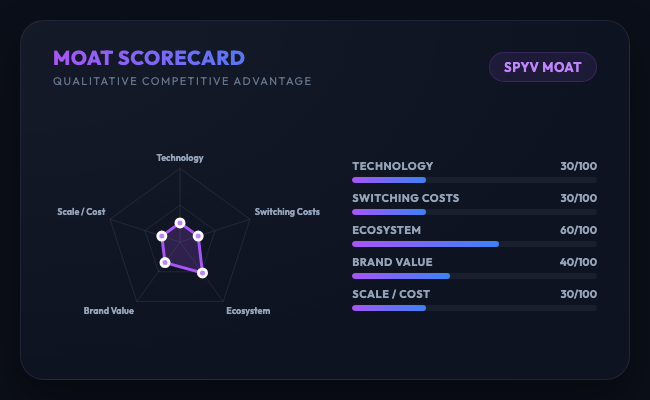
SPYV doesn't have a moat. It's a basket. But the holdings inside that basket? That's where the real competitive dynamics live. The calculated proxy scores tell a story of a fund leaning hard on Ecosystem & Partnerships (60) while trailing everywhere else—Technology (30), Switching Costs (30), Brand & Network Effects (40), Cost & Scale Efficiency (30).
Here's the twist: the value segment of the S&P 500 has historically been dominated by financials, industrials, and energy players that thrive on sticky client relationships and massive distribution networks. JPMorgan doesn't need a new AI chip to lock in corporate clients—it needs the Fed, decades of trust, and the fact that no CFO is waking up and switching banks for fun. That's switching costs in action.
But the scorecard is right to punish the low numbers. The ETF itself has zero pricing power. It doesn't hold proprietary tech. It's a pass-through vehicle. The entire moat is secondhand—borrowed from the underlying companies. And with no revenue data to confirm whether those companies are actually widening their margins or fending off disruptors, investors are flying on autopilot.
The truth? This is a low-moat product wrapped in a moderate-moat index. The 60-point Ecosystem score is the only bright spot—S&P Global's index construction and rebalancing mechanisms mean SPYV automatically captures the "value" cohort as it shifts. That's a structural advantage no single stock can replicate.

Milestones That Moved the Needle
Two events are separating the hype from the fundamentals right now:
- July 28, 2026 – S&P Global Q2 Earnings. This is the single biggest data point for SPYV holders. The parent company's earnings call will reveal dividend flows, buyback activity, and sector rotation trends across the value index. If S&P Global signals that value holdings are generating higher free cash flow, the opaque fog lifts. If not, $61.85 gets even harder to justify.
- SpaceX Nasdaq-100 Inclusion (This Week). Starting Tuesday, SpaceX (SPCX) joins the Nasdaq-100. That's a massive liquidity event. Millions of investors will suddenly hold SpaceX indirectly through QQQ and related ETFs. The broader implication? It shifts the "value vs. growth" debate. SpaceX is a high-growth, high-hype name landing in a tech-heavy index, while SPYV sticks to boring value. The divergence between these two worlds is about to get a lot more visible.
Catalyst: The AI Tailwind That Blew Into Value Territory
The market is pricing SPYV as if it has zero growth. But the news flow says otherwise:
- Robinhood and Dell triggering buy signals with AI tailwinds (News 1). These aren't pure value plays, but their inclusion in broader market optimism drags the entire S&P 500 sentiment higher.
- Nvidia trading at 21.7x forward earnings—below its two-year average of 34x (News 3). If Nvidia rerates upward, it pulls the entire S&P 500 multiple expansion with it, including the value segment.
- Anthropic and OpenAI advancing toward IPOs (News 7). More IPOs = more liquidity = more inflows into index ETFs. SPYV is a passive beneficiary of this wave.
The big catalyst? S&P Global's Q2 report. If management highlights strong operational cash flow from large-cap value constituents, the current price gap closes. Fast.
Headwinds and Blindspots: The Fog Machine
Three things could wreck this setup:
- No fundamental visibility. The biggest blindspot isn't a bad quarter—it's no data at all. The ETF's aggregate revenue, earnings, and cash flow are all black-boxed. Without a trailing P/E or revenue growth, any price move above $61.85 is pure narrative.
- Nasdaq divergence. The Dow hit record highs, but the Nasdaq fell below key levels last week as AI stocks were hammered (News 1). That's a classic "risk-off" rotation out of growth into safety. If that reverses and tech rebounds, value could lose the flow.
- IPO froth eating its own tail. SGX is expecting 20-30 IPOs in 2026 (News 4), and SpaceX's Nasdaq-100 inclusion is pumping billions into hype-driven names. SPYV is insulated from the direct speculation, but if the broader IPO craze turns into a correction (like the 2021 SPAC implosion), value gets dragged down with the rest.
FAQ: What the Smart Money Is Asking Right Now
1. "Should I buy SPYV before S&P Global's Q2 earnings on July 28?"
Not until you see the data. The ETF is trading at a 52-week high with zero fundamental visibility. The earnings call could swing sentiment 10-15% in either direction. If S&P Global reveals strong buyback and dividend activity across value holdings, the fog lifts and fair value could be above $61.85. But if they signal slowing growth or margin compression across the index, the stock is overpriced. The only smart play is waiting until July 28, then deciding.
2. "Is SpaceX's Nasdaq-100 inclusion bullish or bearish for SPYV?"
Neutral with a slight bullish tilt. SpaceX joining QQQ means billions of passive dollars flowing into a high-growth name. That diverts attention away from value stocks in the short term. But the longer-term effect is positive: higher IPO activity and ETF liquidity mean more capital sloshing into the S&P 500 ecosystem. SPYV beneficiaries from a rising tide, even if it's not leading the charge.
3. "Can SPYV actually beat the S&P 500 Growth ETF (SPYG) this year?"
Only if the macro cycle flips hard back to value. The numbers don't lie: SPYG holds the growth premium (higher P/S, higher expectations), while SPYV is anchored by steady-Eddie cash flows. With the Dow at record highs and the Nasdaq falling, there's a rotation happening—but without earnings data, it's too early to call. If Q3 earnings season shows value stocks delivering stronger than expected FCF, SPYV could outperform. If tech rebounds and AI names rally again, growth wins.
Concluding Call: The Wait-and-See Threshold
SPYV at $61.85 is a momentum bet, not a value play. The ETF has zero fundamental data to anchor its price, the moat scores are mediocre, and the only real catalyst is a single earnings call two weeks away.
Investors aren't paying for earnings power or competitive advantages—they're paying for a narrative that might or might not materialize. Until S&P Global reports on July 28, the smartest trade is no trade. If the data confirms value holdings are generating real cash, the entry gap narrows. If not, this 52-week high could be the peak of a sentiment-driven cycle.
🔗 Recommended Valuation Breakdowns
⚠️ Disclaimer
This analysis is provided for informational and educational purposes only and does not constitute financial, investment, or professional advice. Investing in financial markets involves risks, and you should perform your own research or consult with a professional adviser. Past performance is not indicative of future results.
댓글
댓글 쓰기