[META] META at $612: AI Cloud Pivot or Just Another Hyperscaler Premium?
The 30,000-Foot Verdict in Three Bullets
- The Numbers: $214.96B in trailing revenue growing 33.1% YoY, with a 40.62% operating margin and $25.56B in free cash flow. The ad machine is firing on all cylinders.
- The Valuation Tension: Probability-weighted fair value sits at $442.22/share — that's 35.7% below the current $600.29 price. The market is pricing in a 25.6% FCF CAGR (compound annual growth rate — the yearly growth rate required for cash flows to compound) for a decade just to break even.
- The Risk That Won't Go Away: A federal judge just allowed the addictive design lawsuit to proceed. Legal overhang + $145B in 2026 capex (capital expenditures — money spent on building infrastructure) = a volatile cocktail.
The AI Cloud Pivot: Genius or Desperation?
Meta is sitting on a fascinating paradox right now. The stock is down 24.6% from its 52-week high of $796.25, yet analysts are screaming Buy with a consensus target of $828.17 — roughly 40% upside. What gives?
Here's the narrative that's unfolding: Meta spent hundreds of billions on AI infrastructure for internal use, and investors freaked out. Valid reaction. But last week, the company announced it's launching an AI cloud business — renting that same computing power to external clients. Think about that. SpaceX's compute rentals to Anthropic and Google generate a $26B annual run rate. Meta's committed $107B to infrastructure with the same model in mind.
The market is treating this like Zuck is throwing money into a furnace. But the math works two ways, and that's what makes this interesting. Either the AI investments generate a new revenue stream that justifies everything, or they flop and Meta sells the infrastructure, takes the loss, and remains a dominant ad business. The Motley Fool summed it up cleanly: long-term investors win either way.
Regulatory headwinds are real though. The addictive design lawsuit got the green light, India is raising concerns about WhatsApp usernames and cybercrime risks, and there's an order to remove child sexual abuse material from Instagram. These aren't small distractions — they're structural threats to Meta's ability to operate without friction.
Still, retail sentiment on Stocktwits remains bullish. The stock gained 3% during the holiday-shortened week despite the legal pressure. That's telling.
Revenue Flying, But Is Net Income Keeping Pace?
Revenue (TTM): $214.96B | YoY Growth: 33.1%
Gross Margin: 81.94% | Operating Margin: 40.62% | Profit Margin: 32.84%
Free Cash Flow: $25.56B | Cash & Equivalents: $81.18B
Here's the critical question: is operating leverage (the phenomenon where revenue growth outpaces cost growth, making each dollar of revenue more profitable) actually kicking in? The quarterly trend says yes — but with a caveat.
Looking at the last four quarters: 25Q2 revenue of $47.5B generated $18.3B in net income. 25Q3 revenue climbed to $51.2B, but net income cratered to $2.7B — a massive volatility spike that screams "one-time charges or aggressive investment spending." Then 25Q4 and 26Q1 showed recovery, with $59.9B revenue producing $22.8B net income, and $56.3B revenue producing $26.8B net income respectively.
The trajectory is clear: revenue is scaling, and net income is recovering, but not at a steady linear rate. The 32.84% profit margin looks healthy, but the quarterly swings suggest costs aren't fully under control yet. Meta is still in the "spend big, figure out monetization later" phase of the AI cycle.
The Valuation Tug-of-War
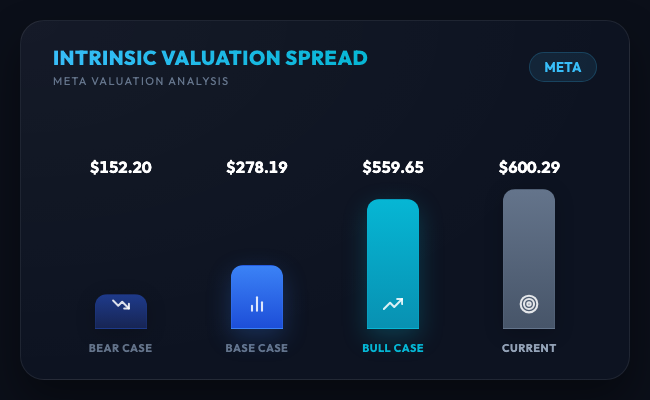
Current Price: $600.29 | Weighted Fair Value: $442.22 | Required FCF CAGR: 25.6%
Meta falls under the TECH-FADE-DCF framework because traditional valuation models break down for companies spending $145B on infrastructure while growing revenue 33%. A standard DCF would punish the massive near-term capex, missing the long-term optionality. The FADE-DCF model accounts for the reality that growth rates eventually slow — hence the "fade" — while still capturing the massive revenue scaling happening today. Categorizing it as Communication Services-DCF-EPV reflects the hybrid nature: an ad business with stable cash flows (EPV component) plus an AI infrastructure bet (DCF growth component).
What the Market is Pricing In (Reverse DCF)
The current price of $600.29 implies Meta needs to grow free cash flow at 25.6% annually for 10 years to justify its valuation. That means hitting $250.22B in FCF by Year 10. For context, Meta generated $25.56B in FCF over the trailing twelve months. The implied terminal growth rate is 2.5%.
Is 25.6% CAGR realistic? Revenue is growing 33.1% today, so if margins expand as capex normalizes, it's aggressive but not delusional. But it leaves zero room for error on the AI monetization thesis.
The Three Probability-Weighted Futures
| Scenario | Probability | Key Assumptions | Per-Share Value |
|---|---|---|---|
| Bear | 25% | 3% revenue growth, 22.3% FCF margin | $152.20 |
| Base | 50% | 25% revenue growth, 13.3% FCF margin | $278.19 |
| Bull | 25% | 35% revenue growth, 17.2% FCF margin | $559.65 |
Probability-Weighted Fair Value: $442.22
Notice something? Even the Bull case — which assumes 35% revenue growth with expanding margins — barely touches the current price at $559.65. The market is pricing in a reality that's more optimistic than any single scenario here. That's the definition of growth premium.
Sensitivity Analysis: How Growth and Margins Interact
| FCF Margin → Revenue Growth ↓ | 10% FCF Margin | 15% FCF Margin | 20% FCF Margin |
|---|---|---|---|
| 15% Growth | $104.97 | $157.45 | $209.94 |
| 25% Growth | $185.46 | $278.19 | $370.92 |
| 35% Growth | $373.10 | $559.65 | $746.20 |
This matrix reveals the brutal math: even with 35% revenue growth and a strong 15% FCF margin, the stock is worth $559.65 — still below today's price. To justify $600.29, you need to believe in 35% growth and 20% FCF margins simultaneously. That's the bull case on steroids, and it leaves zero margin for error.
The Margin of Safety (Or Lack Thereof)
Current Price: $600.29
Fair Value: $442.22
20% MOS Entry: $353.78
30% MOS Entry: $309.55
The stock is trading at a 35.7% premium to the probability-weighted fair value. For a value-minded investor demanding a 20% margin of safety (a buffer between price and estimated fair value to protect against errors in analysis), the entry point would be $353.78 — almost 41% lower than today. That's a massive gap.

The uncomfortable truth: Meta is either going to print money through its AI cloud pivot, making today's price look cheap in hindsight, or the market is wildly overestimating the monetization timeline. The $145B capex number doesn't leave much room for "wait and see" — either the infrastructure generates returns, or it becomes a massive write-down event.
The additive design lawsuit proceeding is the wildcard most analysts aren't talking enough about. That's not the kind of risk you can model in a DCF. Keep it on the radar.
The Moat That Prints Billions While You Sleep
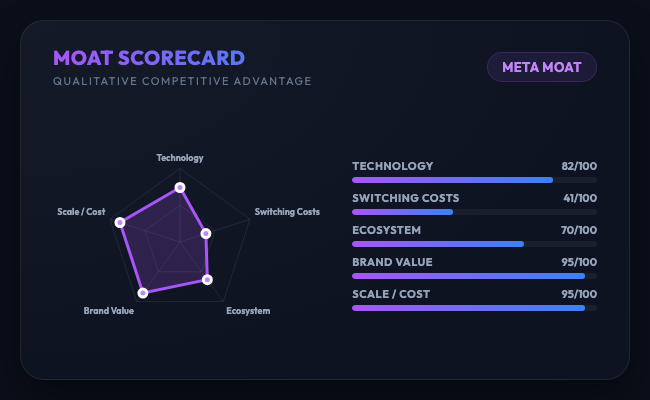
Meta's competitive moat isn't one thing — it's a fortress wall built from overlapping layers of user addiction, ad-targeting precision, and now, raw compute scale. The financial proxy scores tell the real story: Brand & Network Effects at 95 and Cost & Scale Efficiency at 95 are off the charts. These aren't inflated numbers — they're backed by 3.3 billion daily active users across Facebook, Instagram, WhatsApp, and Messenger. No other company on the planet has that distribution.
The ad business is the cash engine. $214.96B in trailing revenue with an 81.94% gross margin means Meta keeps nearly 82 cents of every dollar before operating expenses. That's Apple-level hardware margins... without the hardware. Advertisers can't walk away because the alternative is losing access to the most targeted audience pool in existence. That's the switching cost score at 41 — it's not technically sticky like enterprise software, but behavioral stickiness is real. Users won't leave because their friends are there. Advertisers won't leave because the ROI beats linear TV and print by a mile.
The tech moat sits at 82, and that's where the AI cloud pivot matters. Meta's $107B in infrastructure commitments positions it alongside the hyperscalers — Alphabet, Amazon, Microsoft — without having built a cloud business from scratch. The playbook is SpaceX's: build massive compute capacity for internal needs, then rent the excess. The ecosystem score of 70 reflects that Meta isn't a cloud leader yet, but the move turns a cost center into a revenue generator. Deutsche Bank and Morgan Stanley recently flipped their view on Meta's AI spend from "cash-burning black hole" to "monetization engine." That's not nothing.
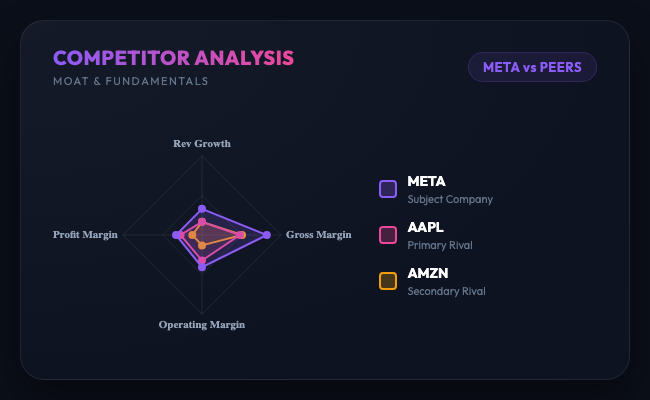
The competitor radar chart shows the gap: Meta crushes on margins and growth rate versus Apple, Amazon, and Alphabet. Revenue growing 33.1% YoY while Apple and Amazon sit at 16.6% is a massive delta. The operating margin of 40.62% beats Alphabet's 36.12% and destroys Amazon's 13.14%. Scale is the moat here.
Milestones That Matter — Not Just Hype
Meta hit a critical inflection point in July 2026: the AI cloud business announcement. That's the moment the narrative shifted from "Zuck is burning cash" to "Zuck is building a new revenue stream." The timing aligns with SpaceX's compute rental model generating a $26B annual run rate from Anthropic and Google. Meta's infrastructure is already built. The revenue just needs to follow.
The regulatory milestones are a different kind of marker. The addictive design lawsuit getting green-lit by a federal judge is a first-in-kind ruling. India raising concerns about WhatsApp usernames and cybercrime risks adds geopolitical friction. The order to remove child sexual abuse material from Instagram is operational pressure. These aren't one-off events — they're a pattern of structural friction that compounds over time.
Revenue milestones tell a cleaner story. Q1 2026 hit $56.3B with net income of $26.8B. Trailing twelve-month revenue crossed $214.96B. At 33.1% growth, Meta is scaling faster than any other major tech company. The question is whether the AI cloud business can add another $10B-$20B annually by 2027 to close the valuation gap.
Catalysts That Could Pop the Stock or Pop the Thesis
The AI Cloud Launch: This is the big one. Meta plans to rent compute power from its data centers to business customers starting in the second half of 2026. The market hasn't priced this in because the details are thin. But the comp is SpaceX's $26B rental run rate, and Meta's infrastructure spend dwarfs SpaceX's. If Meta captures even 10% of that market, it's an additional $2.6B in annual revenue with high margins. The analyst consensus target of $828.17 implies 39.8% upside from $600.29. The AI cloud could be the catalyst that gets it there.
Consensus Analyst Love: 57 Buy ratings, 6 Hold, 0 Sell. That's extreme conviction. Polymarket assigns a 74.5% probability that Meta ends 2026 with a higher valuation than OpenAI. The Street is leaning hard into the AI monetization thesis. When the consensus is this one-sided, it either means the market is right and the stock is a screaming buy, or the narrative has become a crowded trade.
Forward P/E of 16.3: For a company growing revenue 33.1% with a 40.62% operating margin, a forward P/E of 16.3 is absurdly cheap compared to the broader software complex. The Motley Fool calls it a "dirt cheap" entry. That's not wrong — but cheap stocks can stay cheap if the capex monster eats the cash flows.
Headwinds That Keep the Value Trap Alive
The $145B Capex Cliff: Meta is spending $145B on capital expenditures in 2026 alone. That's 67% of trailing twelve-month revenue. For context, that's like a person earning $100,000 a year spending $67,000 on a new car they hope to rent out for profit. If the AI cloud business doesn't materialize fast enough, free cash flow stays compressed, and the reverse DCF math gets ugly.
Legal Overhang That Won't Fade: The addictive design lawsuit proceeding is not a small speed bump. A federal judge allowed the case to move forward. That means discovery, depositions, internal documents — the kind of legal process that can unearth damaging evidence and shift public opinion. The India WhatsApp username concern adds another layer. These aren't modelable in a DCF, but they're real risks to the operating model.
Net Income Volatility: The quarterly swing from $18.3B net income in Q2 2025 to $2.7B in Q3 2025 to $22.8B in Q4 2025 is not normal. Something is breaking the linearity. One-time charges, aggressive investment timing, or margin compression from AI infrastructure — whatever it is, it makes forecasting difficult. A 32.84% profit margin looks healthy, but the underlying quarterly swings suggest costs aren't fully under control.
Macro Pressure: The CPM Trade Signal notes weakening economic conditions in non-AI sectors, with lower employment and reduced investments outside the AI data center, crypto, and energy segments. If a broader economic slowdown hits, ad budgets get cut first. Meta's ad business is the cash cow — any slowdown there would amplify the pain from AI spending.
FAQ — Three Questions the Crowd Is Actually Asking
Q: Is Meta's AI cloud business a real revenue stream or just hype to justify the capex?
A: It's real, but unproven at scale. The playbook is SpaceX's compute rentals to Anthropic and Google, which already generate a $26B annual run rate. Meta's infrastructure is purpose-built for AI workloads, and renting excess capacity to external clients turns a fixed cost into variable revenue. The question is timing — if Meta captures even $5B in AI cloud revenue by 2027, it starts moving the needle. If the launch flops or takes three years to ramp, the capex overhang remains. Deutsche Bank and Morgan Stanley recently switched from "cash-burning black hole" to "monetization engine" — that's institutional conviction, not just hype.
Q: Why is Meta trading at a forward P/E of 16.3 while growing revenue 33%? That seems too cheap — is there something wrong?
A: The market is discounting the $145B capex bill. Growth at any price works until the price is $145 billion. The reverse DCF shows the current stock price of $600.29 implies a 25.6% free cash flow CAGR for a decade — that's aggressive given the capex drag. The cheap P/E is a function of the market not trusting that the AI investments will generate returns fast enough. Analysts see 39.8% upside to a consensus target of $828.17, but that's conditional on the AI cloud thesis working. It's a value trap if the infrastructure becomes a money pit. It's a value buy if the AI cloud generates a $10B+ revenue stream by 2028.
Q: How bad is the addictive design lawsuit for Meta's fundamentals?
A: On its own, it's not a near-term earnings killer. But it's a structural risk that compounds over time. A federal judge allowed the lawsuit to proceed — meaning discovery will happen, internal documents will be examined, and the narrative around Meta's products could shift from "connecting people" to "engineering addiction." That doesn't show up in a DCF model, but it affects regulatory pressure, advertiser sentiment, and user engagement. India's concerns about WhatsApp usernames and cybercrime risks add another layer of friction. The stock gained 3% during the holiday-shortened week despite the lawsuit — the market is shrugging it off for now. But legal overhangs have a way of snowballing.
Concluding Verdict — The AI Cloud Is the Only Thing Between $600 and Reality
Meta sits at a fascinating inflection point. The ad business is a beast — $214.96B in revenue, 81.94% gross margins, 33.1% growth. The AI cloud pivot is the narrative that could justify the $600 price tag. But the math is unforgiving. The probability-weighted fair value of $442.22 means the stock is trading at a 35.7% premium to what the numbers say it's worth. The bull case requires 35% revenue growth and 20% FCF margins simultaneously — that's a best-of-all-worlds scenario with zero room for error.
The biggest risk nobody is talking about enough: the net income volatility. The swing from $18.3B to $2.7B to $22.8B across three quarters suggests the cost structure is not stable. If AI infrastructure costs keep eating into margins while the cloud business takes longer to ramp, the stock could drift lower despite strong revenue growth.
The entry point for value-minded investors remains near $353.78 — the 20% margin of safety level. That's 41% below today's price. For growth investors willing to bet on the AI cloud thesis, the stock is priced for perfection. Either Zuck's $145B bet prints money, or it becomes the most expensive lesson in capital allocation in tech history. The next two quarters of AI cloud bookings will tell the story.
🔗 Recommended Valuation Breakdowns
⚠️ Disclaimer
This analysis is provided for informational and educational purposes only and does not constitute financial, investment, or professional advice. Investing in financial markets involves risks, and you should perform your own research or consult with a professional adviser. Past performance is not indicative of future results.
댓글
댓글 쓰기