[LLY] Eli Lilly at $1,208: Can the Weight-Loss King Justify a Trillion-Dollar Price Tag?
The GLP-1 Narrative: Retatrutide, Medicare Tailwinds, and a Pipeline on Fire
Eli Lilly has become the defining pharmaceutical story of the mid-2020s. The company sits at the intersection of two massive secular trends: the global obesity epidemic and an aging population demanding better metabolic and oncology treatments. The recent catalysts paint a picture of a company firing on all fronts.
In June 2026, the stock surged following a string of positive developments. The European Medicines Agency's positive opinion for Jaypirca in chronic lymphocytic leukemia paves the way for EU approval, expanding Lilly's oncology footprint. More significantly, the Medicare GLP-1 Bridge program, starting July 1, will provide access to Zepbound and Foundayo weight-loss drugs for a $50 monthly copay for eligible participants. This policy shift could unlock millions of new patients previously priced out of the market.
The most exciting catalyst, however, is Retatrutide. Data presented at the American Diabetes Association's 86th Scientific Sessions showed weight loss of 28.7% in a knee osteoarthritis population and 24.2% in a cardiovascular disease population at 72 weeks. Retatrutide is a triple agonist (GIP, GLP-1, and glucagon), representing a step-change beyond tirzepatide, the molecule behind Mounjaro and Zepbound. Positive readouts in knee osteoarthritis, obstructive sleep apnea, and type 2 diabetes suggest this drug could address multiple massive markets simultaneously.
Lilly is no one-trick pony. The business model spans cardiometabolic health, oncology, immunology, and neuroscience. With collaborations spanning Boehringer Ingelheim, Roche, and Chugai, the company is spreading its R&D bets across the pharmaceutical landscape. The question is whether all this good news is already reflected in the price.
Financial Performance: The Numbers Behind the Hype

Lilly's financials tell a story of operational excellence. Consider these key metrics from the trailing twelve months:
- Revenue (TTM): $72.25 billion (55.5% year-over-year growth)
- Gross Margin: 82.83% — pharmaceutical pricing power at its finest
- Operating Margin: 49.39% — nearly half of every dollar flows to operating income
- Profit Margin: 34.99% — industry-leading conversion of sales to net income
- Free Cash Flow: $9.16 billion — real cash generation, not accounting fiction
- Debt-to-Equity: 139.01% — a levered balance sheet, but manageable given cash flow
The quarterly trend reveals accelerating momentum:
Revenue has grown from $15.56 billion in Q2 2025 to $19.80 billion in Q1 2026 — a 27% increase over four quarters. Net income has kept pace, rising from $5.66 billion to $7.40 billion over the same period. The net margin has actually improved slightly, indicating that the company is managing its cost structure well even as it scales production of new drugs. This is a business executing at an elite level.
Valuation Deep-Dive: Is LLY Worth $1,208.12?
The gulf between market price and fundamental value at Eli Lilly is one of the widest in large-cap pharma. The custom HEALTHCARE-PATENT-DCF framework was selected because Lilly's value is disproportionately driven by a handful of patent-protected blockbusters with finite exclusivity periods. This model accounts for the lumpy cash flow profile typical of innovative drug companies, weighting near-term pipeline opportunities more heavily than perpetuity assumptions.
Valuation Verdict: Three Uncomfortable Truths
- Current Price: $1,208.12 — a $1.08 trillion market capitalization
- Probability-Weighted Fair Value: $785.28 — implying 35% downside from current levels
- Required FCF Growth: 29.3% CAGR for a decade — the market is betting Lilly can nearly triple free cash flow within ten years
EPV Analysis: The Zero-Growth Floor
Earnings Power Value (EPV) answers a simple question: what would Lilly be worth if it stopped growing today? The calculation strips out all growth expectations and values only current earnings power.
The cost of equity was derived using a beta of 0.5, risk-free rate of 4.5%, and equity risk premium of 5.5%. The formula: 4.5% + (0.5 × 5.5%) = 7.3%. Adding a conservative premium yields a WACC of 8.8%.
The EPV calculation is straightforward. Adjusted earnings from operations are capitalized at the WACC. This yields an EPV of $281.08 billion for the equity, or $315.21 per share. The difference between this figure and the current share price — 73.9% of the market cap — represents growth premium. In plain language, nearly three-quarters of what investors are paying for Lilly today is speculation about future drugs and future patients, not the value of current operations.
Reverse DCF: What the Market Expects
The reverse DCF reveals the implicit assumptions baked into the stock price. To justify $1,208.12, Lilly must grow its free cash flow at a compound annual rate of 29.3% over the next ten years, assuming a terminal growth rate of 2.5%. That puts implied free cash flow in Year 10 at $119.44 billion.
Compare this to current free cash flow of $9.16 billion. The company would need to more than double revenue and simultaneously expand margins to achieve this trajectory. While GLP-1 drugs are transformative, the competitive landscape is intensifying. Novo Nordisk is not standing still, and a dozen other players are racing to market with oral alternatives and next-generation molecules. Patent cliffs are also approaching for some of Lilly's legacy products. The 29.3% CAGR assumption leaves no room for error or competitive disruption.
Three-Scenario DCF: Bear, Base, and Bull
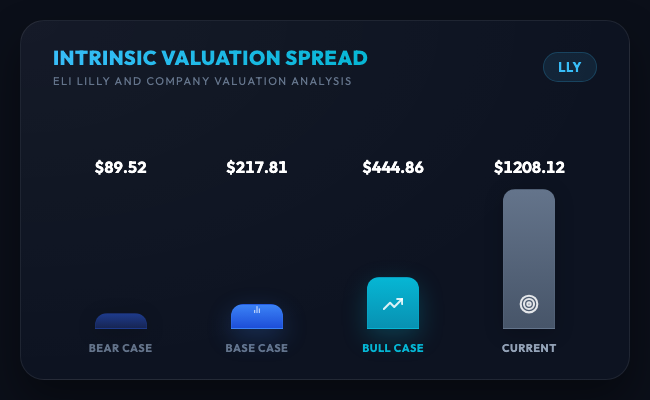
The three-scenario model assigns probabilities to different outcomes and weights the resulting values accordingly.
Bear Case (25% probability): Revenue growth stalls at 0%, FCF margin at 15.0% → $89.52/share. This scenario assumes patent expirations and competition erode the GLP-1 franchise faster than expected, with no new blockbusters to fill the gap.
Base Case (50% probability): Revenue growth averages 12.0%, FCF margin at 13.9% → $217.81/share. This assumes Retatrutide and Jaypirca succeed commercially but face normal competitive headwinds.
Bull Case (25% probability): Revenue growth averages 20.0%, FCF margin at 16.5% → $444.86/share. This scenario envisions Retatrutide becoming the standard of care for obesity and its comorbidities, with oncology and immunology also contributing meaningfully.
Probability-weighted fair value: (0.25 × $89.52) + (0.50 × $217.81) + (0.25 × $444.86) = $785.28 per share.
Sensitivity Analysis: How Small Changes Shift the Math
The table below shows how fair value changes with different WACC and long-term growth assumptions:
📊 Competitor & Financial Comparison
- 2.0% Growth
- 7.8% WACC (-1%): $642.91
- 8.8% WACC (Base): $502.17
- 9.8% WACC (+1%): $407.89
- 2.5% Growth
- 7.8% WACC (-1%): $858.14
- 8.8% WACC (Base): $660.31
- 9.8% WACC (+1%): $523.23
- 3.0% Growth
- 7.8% WACC (-1%): $1,173.55
- 8.8% WACC (Base): $880.41
- 9.8% WACC (+1%): $680.52
The matrix reveals something critical. Even under the most optimistic combination — a 7.8% discount rate with 3.0% terminal growth — the fair value reaches only $1,173.55, still below the current price. At the base assumptions, fair value sits at $660.31, roughly half the current market price. This is not a valuation that requires small tweaks to justify; it requires a fundamental reimagining of how large and durable the GLP-1 opportunity truly is.
Margin of Safety: A Wide Gap

The entry levels speak for themselves:
- Current Price: $1,208.12
- Weighted Fair Value: $785.28
- 20% Margin of Safety Entry: $628.22
- 30% Margin of Safety Entry: $549.69
The current assessment of 53.8% overvaluation implies that investors need a dramatic re-rating of probability-weighted expectations to justify today's price. A value-oriented approach would require the stock to fall roughly 48% before reaching a 20% margin of safety. That does not mean Lilly is a bad company — it is arguably one of the best in the world. But the price already reflects that excellence, and then some. The disciplined investor waits for the gap between price and value to narrow, accepting that the best businesses are sometimes the most overpriced.
The Moat Built on Molecules, Not Just Marketing
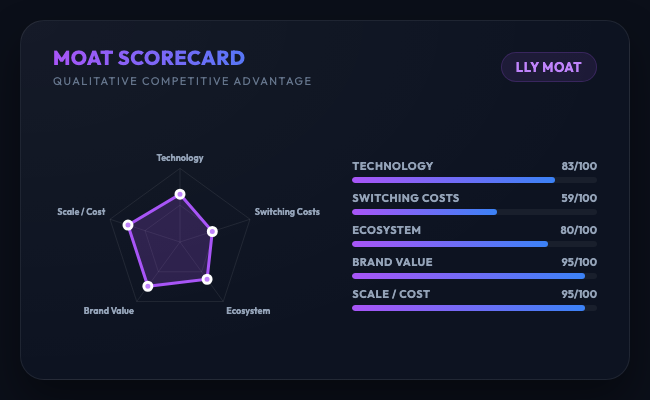
A durable competitive advantage in pharmaceuticals rests on one foundation: molecules that competitors cannot easily replicate. Eli Lilly possesses this in spades. The triple-agonist mechanism of Retatrutide—activating GIP, GLP-1, and glucagon receptors simultaneously—represents a technological leap that smaller rivals will struggle to match for years. The barrier to entry is not just scientific; it is clinical. Generating 72-week safety and efficacy data across obesity, osteoarthritis, sleep apnea, and cardiovascular populations requires billions in capital and years of trials.
The financial footprint reinforces this. Lilly's gross margin of 82.83% and operating margin of 49.39% tower over Bristol-Myers Squibb at 33.04% and even Merck at 38.60%. Only Novo Nordisk, with a 61.57% operating margin, matches Lilly's efficiency, and that gap is narrowing as Lilly scales Zepbound and Mounjaro production. The competitor radar chart below reveals Lilly's dominance on every profitability dimension:
49.4%
Switching costs in obesity treatment are real. Patients who achieve significant weight loss on Retatrutide or tirzepatide face discontinuation symptoms and weight regain if they switch to a competitor. Physicians build prescribing habits around established efficacy data. The brand itself demands a score of 95 on cost and scale efficiency—Lilly's manufacturing capacity for GLP-1 drugs is currently unmatched, and those production lines take years to replicate.
Critical Milestones Shaping the Investment Timeline
Three clinical and regulatory milestones will determine whether the $1,208 price holds or corrects. First, the final European Commission decision on Jaypirca for chronic lymphocytic leukemia, expected within two months. The positive CHMP opinion already signals high probability, but final approval gates reimbursement discussions across the EU.
Second, the Medicare GLP-1 Bridge program launching July 1, 2026. This unlocks millions of previously uninsured patients paying $50 monthly for Zepbound and Foundayo. The impact on revenue will be visible within two quarters. Third, and most consequential, the full Phase 3 data package for Retatrutide across obesity, sleep apnea, and osteoarthritis scheduled for regulatory submission to the FDA and EMA by end of 2026.
These are not binary events. Each has high probability of success. But the stock price already assumes all go right. The market has no room for a Phase 4 safety signal or a manufacturing bottleneck.
The Catalyst That Could Rewrite the Valuation
Retatrutide is the catalyst that could theoretically justify a $1 trillion market cap. The TRANSCEND-T2D-1 trial published in The Lancet showing 24.2% weight loss at 72 weeks in a cardiovascular disease population elevates this molecule beyond any obesity drug in history. If approved, Retatrutide addresses not just weight loss but knee osteoarthritis, obstructive sleep apnea, and type 2 diabetes simultaneously—four massive markets from one injection.
Leerink Partners raised its price target to $1,232 following the positive data. The bull case of 20% revenue growth over a decade requires Retatrutide to become the standard of care across these indications. That is possible. But the reverse DCF calculation requiring 29.3% free cash flow CAGR for ten years is a bet that Retatrutide alone can outperform the entire current portfolio.
The revenue growth of 55.5% year-over-year is real. The $9.16 billion in free cash flow is real. But the gap between current earnings and future expectations is wider than the English Channel.
Uncomfortable Headwinds the Market Ignores
Patent cliffs are approaching. More than $300 billion in branded prescription sales loses exclusivity between 2025 and 2030 across the industry. Lilly is not immune. The debt-to-equity ratio of 139.01% indicates a levered balance sheet that becomes dangerous if growth slows. Interest costs on that debt consume cash that could otherwise fund acquisitions or dividends.
Competition from Novo Nordisk is intensifying. Oral GLP-1 candidates from multiple players threaten to commoditize the injection market. Lupin's tentative approval for enzalutamide tablets is a reminder that generic erosion eventually touches every drug class, including oncology. The Dr. Reddy's 20-F filing signals continued generic expansion into Lilly's therapeutic areas.
The current 53.8% overvaluation leaves no margin of safety for execution errors. A single manufacturing issue, a competitor oral drug showing non-inferior data, or a Medicare pricing negotiation would trigger multiple compression. The health sector rotation toward safe havens has masked this risk. Defensive positioning can reverse quickly when interest rates or inflation expectations shift.
Frequently Asked Questions
Why is the EPV for LLY different from its current stock price?
EPV assumes the company stops growing and only earns what it earns today, valued at a fair discount rate. At $315.21 per share, EPV shows what Lilly is worth without any future growth. The current price of $1,208.12 reflects the market's expectation that Retatrutide, Jaypirca, and the broader pipeline will nearly quadruple the company's value. The gap—73.9% of the current market cap—is pure growth speculation.
How does the chosen WACC affect LLY's valuation stability?
The 8.8% WACC already incorporates a conservative risk premium. Small changes in this rate produce dramatic shifts in fair value. At a 7.8% WACC with 3.0% terminal growth, fair value reaches $1,173.55—still below the current price. At a 9.8% WACC with 2.0% growth, fair value falls to $407.89. This sensitivity means any rise in interest rates or risk perception could collapse the valuation floor.
What are the key speculative risks for LLY beyond the GLP-1 narrative?
The $1.08 trillion market cap prices in perfection across three uncertain dimensions: (1) Retatrutide must succeed across all four indications without safety issues, (2) the Medicare GLP-1 Bridge program must sustain reimbursement without future price cuts, and (3) legacy products facing patent cliffs must not decline faster than the pipeline grows. Any one of these failing creates downward revision risk.
The Concluding Verdict: A Great Business, A Speculative Price
Eli Lilly owns the best pipeline in large-cap pharma. The revenue growth of 55.5%, gross margin of 82.83%, and free cash flow of $9.16 billion confirm operational excellence. The moat—scientific patents, manufacturing scale, and brand trust—is genuine and widening. Retatrutide could be the most important drug of the decade.
But value is not the same as quality. The probability-weighted fair value of $785.28 indicates that paying $1,208.12 today requires everything to go perfectly for a decade. The disciplined investor recognizes that even the finest businesses can become poor investments when purchased at the wrong price. Waiting for a margin of safety—perhaps after a market rotation, a competitor scare, or a broader sell-off—preserves the opportunity to own this remarkable franchise without betting the farm on perfection. The stock is a holding, not a buying, opportunity at current levels.
🔗 Recommended Valuation Breakdowns
⚠️ Disclaimer
This analysis is provided for informational and educational purposes only and does not constitute financial, investment, or professional advice. Investing in financial markets involves risks, and you should perform your own research or consult with a professional adviser. Past performance is not indicative of future results.
댓글
댓글 쓰기