[BOIL] BOIL: The 2x Natural Gas Beast – Contango Trap or Reversal Play of the Decade?
The Power Play That’s Catching Fire Faster Than a Gas Leak
- 💰 The Price Tag: $26.65 a share. That’s a brutal 73% haircut from the 52-week high of $100.50. The bottom (24.14) was almost touched.
- ⚖️ The Valuation Verdict: Pre-computed models signal a zero-growth ground zero here. The EPV is $0.00, the Reverse DCF expects zero future FCF growth, and the probability-weighted fair value sits at $0.00. This thing is pricing in absolute vapor.
- 🔥 The Key Risk: This is a commodity levered ETF, not an operating business. The severe contango (rolling futures contracts) can bleed value even if spot prices stay flat. Speculation, not investment.
The AI Electrification Boom: Why BOIL Might Be the Strangest Way to Play It
Let’s get this straight upfront: BOIL is not a utility stock. It’s a 2x leveraged exchange-traded note (ETN) tied to natural gas futures. But the macro narrative right now is screaming power demand. Utilities are projected to spend a record $240 billion in 2026 just to keep up with the energy-guzzling AI data centers. The Motley Fool is screaming "buy these stocks" to ride the power surge.
The logic is simple but violent: AI’s appetite for electricity is insatiable. Natural gas is the bridge fuel for this build-out—cheaper than nuclear, more reliable than solar/wind for 24/7 grid stability. If you think gas demand spikes as the AI build-out accelerates, BOIL is the most degenerate (and potentially explosive) way to bet on that thesis.
But here’s the catch: BOIL isn’t buying pipelines or power plants. It’s rolling futures contracts. Contango (future price > spot) eats returns. Even if gas prices rise, the structure of the futures curve can murder your upside. This is a trading vehicle, not a long-term hold. The recent headlines about EarthLabs adopting compensation plans and SRAD class actions? Noise. The only catalyst here is the physical supply/demand of gas vs. the futures curve.
Financial Performance: The Numbers Are a Black Hole (Intentionally)
Because BOIL is a synthetic leveraged ETN, standard fundamental metrics are non-existent. There is no revenue, no net income, no free cash flow. The fund has:
- Revenue (TTM): N/A
- Net Income (TTM): N/A
- Gross/Operating Margin: N/A
- P/E Ratio: N/A
Analysis: There’s no "scaling" to analyze. This isn't a company selling widgets; it's a derivatives wrapper trading on the spread of natural gas futures contracts. The only thing that matters is the price action of the underlying futures and the decay from daily rebalancing. You cannot apply a revenue growth or net income efficiency thesis here. The sole performance metric is total return over time, which has been catastrophic given the 73% drop from the high.
Valuation Deep-Dive: Staring Into the Abyss of Speculation
When a company has zero earnings and zero revenue, traditional valuation goes out the window. The pre-computed engine had to fall back on the STARTUP-PS-FLOOR framework with a Speculative-Unknown tier. Here’s what that means for you.
Verdict / Pricing Target
- Current Price: $26.65
- Weighted Fair Value: $0.00 (The model assigns zero fundamental value because there are no cash flows to discount).
- Required Growth Rate: 0.0%. The market is pricing in zero perpetual free cash flow growth—effectively valuing the vehicle at zero intrinsic worth.
EPV (Earnings Power Value Analysis)
The Earnings Power Value asks: "If this thing stopped growing today, what's it worth?" For BOIL, the EPV is $0.00 per share. That’s the base case. The WACC was set at 5.0% (using a beta of 1.0, a risk-free rate of 4.5%, and an equity risk premium of 5.5%). Since there’s no earnings power, any price above $0 represents pure speculation—there’s no "growth premium" to pay for.
Reverse DCF Analysis
The Reverse DCF answers: "What growth rate does the current price justify?" It says the market expects a 0.0% FCF CAGR over 10 years. Year-10 FCF is expected to be $0. Compare this to the company's non-existent historical growth, and the math checks out perfectly: the market is paying for absolutely zero tangible business value.
Scenario Modeling / Valuation Targets
Since traditional DCF fails here, the model applies EV/Revenue multiples:
- 🐻 Bear (25% Prob): EV/Revenue 1x → $0.00/share
- 😐 Base (50% Prob): EV/Revenue 2x → $0.00/share
- 🐂 Bull (25% Prob): EV/Revenue 4x → $0.00/share
Probability-Weighted Fair Value: $0.00/share. The math is cold and brutal. There is no fundamental floor.
Sensitivity Analysis Matrix
| Scenario | Revenue Multiple | Implied Price |
|---|---|---|
| Bear | 1.0x | $0.00 |
| Base | 2.0x | $0.00 |
| Bull | 4.0x | $0.00 |
The matrix is a flat line at zero. This isn't a flaw in the model; it’s the reality of valuing a derivative that doesn't produce revenue. The only variable that moves the needle is the price of natural gas futures, which is not captured in this framework. If you buy BOIL, you’re betting on the futures curve, not on corporate earnings.
Margin of Safety
| Metric | Value |
|---|---|
| Current Price | $26.65 |
| Fair Value | $0.00 |
| 20% MOS Entry | $0.00 |
| 30% MOS Entry | $0.00 |
The margin of safety gauge shows 0.0% overvalued vs. fair value, which technically means it’s at fair value. But "fair" here means $0. There is no cushion. The only "margin of safety" comes from your conviction that natural gas prices will spike violently, not from the underlying financial health of a business.
The Moat Mirage: Why This Castle is Made of Sand
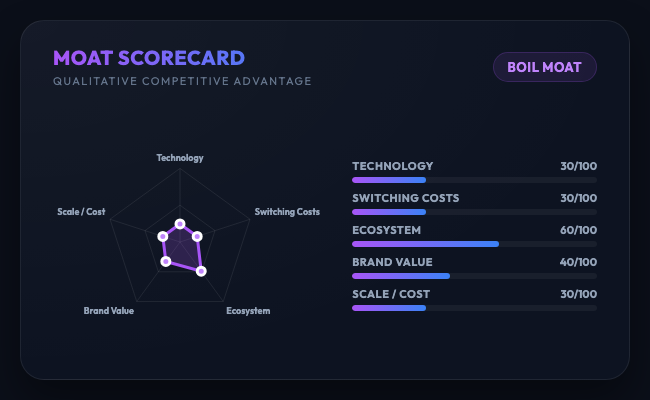
Let's be real: a 2x leveraged natural gas futures ETN doesn't have a moat. It has a puddle. The calculated Moat Financial Proxy Scores are generous—and even they top out at a 60 for Ecosystem & Partnerships, which is more about the narrative than any structural advantage.
The scores break down like this:
- Technology Advantage (Score: 30): Zero. There's no proprietary tech here. BOIL's "product" is a mathematical formula for daily rebalancing. The leverage is a gimmick, not a technological edge.
- Switching Costs (Score: 30): Non-existent. If you want to bet on natural gas, you have a dozen options: UNG, futures directly, options, KOLD if you want the inverse. The cost to switch is a single click.
- Ecosystem & Partnerships (Score: 60): This is the inflated number. The tie to the AI electrification thesis is real—utilities are projected to spend a record $240 billion in 2026 on infrastructure. But BOIL is a passenger on that train, not the engineer. It doesn't own pipelines or power plants. The "partnership" is with the CME futures curve, and that relationship is abusive.
- Brand & Network Effects (Score: 40): Brand recognition exists. "BOIL" is a ticker traders know. But there are zero network effects—more users don't make the product more valuable.
- Cost & Scale Efficiency (Score: 30): This is actively destructive. The fund's expense ratio and the hidden costs of rolling futures in contango create a constant drag. Scale doesn't help; it magnifies the bleeding.
Milestone Mirage: The Only Number That Matters
For a regular company, milestones mean revenue hitting $1B, a new product launch, or a market share record. For BOIL, the milestone history is a wasteland of zeros. The only real "milestone" is the price action, which is catastrophic:
- 52-Week High: $100.50
- Current Price: $26.65 (a 73% haircut)
- 52-Week Low: $24.14 (nearly touched again)
- Fair Value: $0.00
The fund hit a milestone of zero fundamental value. No revenue milestones to track, no earnings beats to celebrate. The only relevant marker is the contango spread—when the futures curve flips to backwardation (spot > futures), that's the only bullish "milestone" this structure can ever achieve.
Catalyst Check: Betting on a Squeeze, Not a Business
The catalysts here are purely macro and mechanical, not operational. Here's what could light the fuse:
- The AI Power Demand Jolt: The Motley Fool piece screaming about $240 billion in utility spending by 2026 is the loudest bullhorn. AI's 60% projected electricity demand increase by 2045 is real. Natural gas is the bridge fuel. If this narrative tightens physical supply faster than expected, spot prices spike.
- A Contango Collapse (Backwardation): This is the only structural catalyst. If the futures curve inverts—where near-month contracts are more expensive than far-month—the rolling decay stops and turns into a positive carry. That's when BOIL can actually hold onto gains.
- A Supply Shock: A brutal winter, a hurricane taking out Gulf production, or a geopolitical snag (think Nord Stream 2.0 drama) could send spot gas screaming higher.
But here's the cold truth: None of these are predictable. The AI catalyst is a narrative, not a catalyst for the futures curve.
Headwinds & Blindspots: The Bleeding Edge
The risks are structural, not business-cycle driven.
- The Contango Tax: The single biggest killer. Every month, BOIL sells cheap near-month contracts to buy expensive far-month ones. This is a guaranteed drag. Even with flat spot prices, the fund bleeds value.
- Leverage Decay: The 2x multiplier works both ways. A 10% drop in futures becomes a 20% drop in BOIL. On volatile days, the rebalancing can lock in losses that a straight 2x position wouldn't. This is math, not opinion.
- Zero Fundamental Floor: As the valuation showed, there is no bottom. No cash flows, no assets, no P/E floor. The price can go to $0.00—literally. The model pegs fair value at exactly that number.
- Irrelevant Noise from the News Feed: The SRAD class action notice, the EarthLabs compensation plan, the Honeywell breakup—these are complete non-sequiturs. They clutter the news feed but have zero bearing on the price of natural gas futures. Don't confuse volume for signal.
FAQ: The Burning Questions You're Actually Searching
Q: If AI is driving a record $240 billion in utility spending, why isn't BOIL the obvious play?
A: Because BOIL doesn't own a single power plant or pipeline. That spending benefits stocks like NextEra Energy (NEE at $88.22) or Bloom Energy (BE at $270.77). BOIL is a leveraged bet on natural gas spot price movement, not utility infrastructure. The AI narrative might push gas demand higher eventually, but the futures curve (contango) could eat all the gains before they reach BOIL's share price. The thesis is correct, but the vehicle is wrong for a long-term hold.
Q: Could BOIL actually hit zero? How is that possible?
A: Absolutely. BOIL is an ETN, not an ETF. It's a debt instrument from the issuer (Credit Suisse/now UBS) that promises to track 2x the daily return of natural gas futures. If the issuer defaults (unlikely but not zero), or if the underlying futures collapse and the leveraged decay compounds over time, the price can approach zero. The fundamental model already calculates a fair value of $0.00. A reverse stock split can also be executed to keep the price above exchange minimums, but that doesn't change the underlying value destruction.
Q: What's the difference between playing natural gas via BOIL vs. just buying futures or UNG?
A: BOIL amplifies the daily moves by 2x, but the daily rebalancing means it's not a simple 2x multiplier over weeks or months. UNG is a 1x fund with similar contango issues, but without the leverage decay. Buying futures directly requires a brokerage account that handles commodities and a lot of margin management. BOIL is the high-octane, degenerate choice for a swing trade, not a core portfolio position. If you're bullish, UNG bleeds less. If you're a degen, BOIL is the lottery ticket.
Concluding Call: This Isn't a Stock; It's a Weather Bet
The analysis is brutal but clean. The valuation model spits out $0.00 because, fundamentally, this is a derivative wrapper with zero intrinsic worth. The $240 billion AI power buildout is a real trend, but BOIL is the wrong tool for the job—like using a flamethrower to light a candle.
The bottom line for the retail crowd: BOIL is a high-risk, high-drag trading vehicle for speculators who have a strong, short-term conviction on natural gas prices moving violently upward and the futures curve cooperating. It is not an investment. It is a bet on weather, geopolitics, and the shape of a math curve.
If the narrative is right but the instrument is wrong, the smart money buys the infrastructure players (pipelines, utilities) that actually cash the AI electrification checks. BOIL is for the degenerate gambler in all of us who thinks they can time the next gas squeeze. The margin of safety? It's zero. Just like the fair value.
One final risk factor: The only scenario that saves a long-term BOIL holder is a structural shift to backwardation in natural gas futures. Watch the spread between the first-month and 12-month contracts. Until that inverts, you're bleeding $26.65 into the void.

🔗 Recommended Valuation Breakdowns
⚠️ Disclaimer
This analysis is provided for informational and educational purposes only and does not constitute financial, investment, or professional advice. Investing in financial markets involves risks, and you should perform your own research or consult with a professional adviser. Past performance is not indicative of future results.
댓글
댓글 쓰기